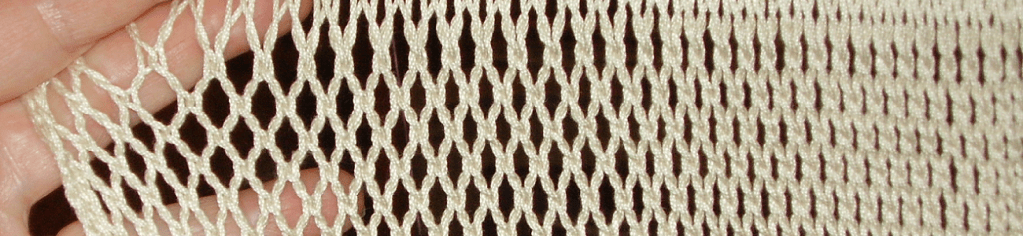
The Språng Journey of Halima al-Rakkasa
Welcome to my world of twisted threads and tangled fingers…
and exploring an ancient technique of making unique fabric: Språng.
I like finding things, learning things, and sharing what I find and learn. With språng, that rabbit-hole started with my desire for a closer-to-accurate suit of clothes for my 11th century Dimashqi persona. Being in a small town, research means google-fu, which is much easier now than it used to be with only the research librarian to rely upon. Fortunately, I learn well by reading, and I adore trying things to see what happens. This is an attempt to give you some of the “moments” I have encountered along the way, memory allowing. (Lesson learned: Record the dates and resources as you go!)
How Did This Journey Begin?
In the process of upgrading my clothing, circa 2005, I found “Clothing of a 14th Century Nubian Bishop” by Elizabeth Crowfoot in Veronika Gervers’ Studies in Textile History.
In addition to line drawings and descriptions of the clothing, there was a reference to a plain språng fragment used as a sash or drawstring. This was the opening, the beginning, the hook.
I found a number of instructions online and a couple of books, but none very clear. Then I ordered an inter-library loan of Peter Collingwood’s “The Techniques of Sprang”. Because he described every movement in detail, it became my favorite functional reference.
Journey Highlights
In the Beginning
Being that it was a new craft for me, I knew I needed to make a few pieces. For practice, I made dozens (probably more) of wee drawstring pouches in linen, and in cotton. This gave opportunity to play with pattern all the way to completion. Perfect practice makes perfect. (They went to Kingdom and Principality largesse.)
My first pouches had the drawstring go through the end loops that were mounted on the beam-sticks (which hold the warp within a larger frame). Later pouches had eyelets for drawstrings, once I learned that lace-type stitch.
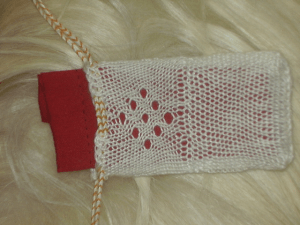
For instance, on the left is is an early pouch of linen, one of many donated to largesse of Tir Righ and An Tir, circa 2010.
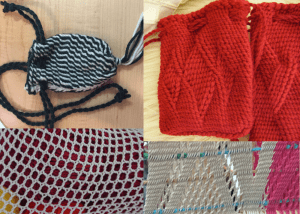
Variations on the theme of interlinking, on the right: color; twist patterns made by changing twist direction of the stitch; grouping of warps in a stitch; and combinations. – image
Experimenting with the basic technique suggested other ideas for use of twist for patterns, and color effects.
2008 – Tir Righ Investiture
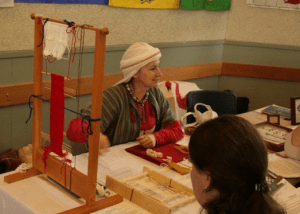
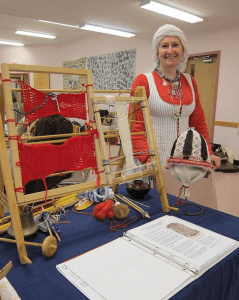
2008 November 22, Tir Righ Investiture A&S Competition, I set up a display and demo of språngwork on a small pouch. You can see, in this photo, one vertical frame, and one lying down. The one flat on the table is an old fabric store trim reel.

Also on the table is a small golden pouch made from wool yarn that I spun and dyed with onion skin.
2010 – for Mark der Gaukler
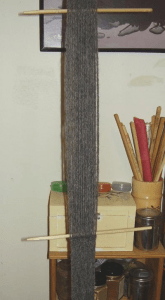
Around April of 2010, Master Mark der Gaukler asked for a braies cord of språngwork. Inspiration came from the drawstring of the trousers of Bishop Timotheos, as described by Elizabeth Carefoot.
My experiments to that point suggested that a flat-worked piece would always spiral, not a comfortable thing for a drawstring of that size. However, Collingwood suggested using alternating rows of Z-twist and S-twist to counter the spiral.
I rigged an eight-foot long 1″ x 4″ to hold my beam-sticks, and mounted a long warp of acrylic yarn (moth-proof and washable).
I started with two rows of soumach twining, and then some plain språng with added eyelets in a triangular pattern. The main body was those alternating Z- and S-rows, and finished the mid line with chaining.
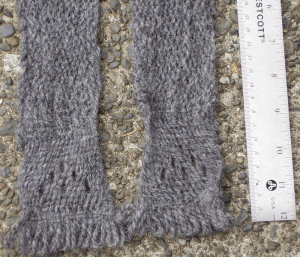
With the “take-up” (inherent in weaving and braiding, using up some of the warp length in the working of the yarn), the final result was about six feet long.
This was a very satisfying project to puzzle over and complete as something close to my vision.

2011 – Tir Righ A&S
Then, in 2011, I finally got a reasonable handle on språng “lace” or openwork beyond single eyelets.
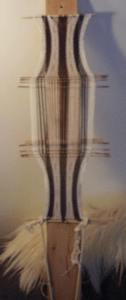
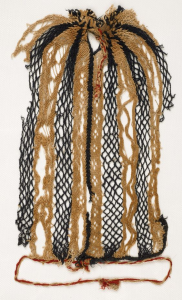
The black-and-white cap at the Whitworth caught my eye for its relatively simple and striking colors, and the lacey patterns that differed on the two colors. I used fibres I had on hand: fine black wool yarn; white linen yarn; and red wool fleece.
2011 Oct 22, Tir Righ A&S Championship, single entry: “A Språngwork Headdress in the Coptic Era”; this is a black wool and white linen cap based on one in the Whitworth Gallery, University of Manchester. The wool for the forehead band spindle-spun, and woven on a backstrap loom. The warp for the cap was mounted on chopsticks, and anchored to a four-foot 1×4.
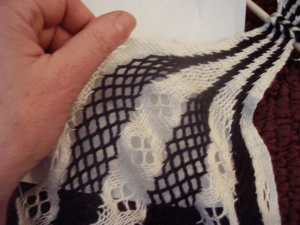
I worked the wool and linen on my plank “frame”. (Notice the grouping of warps as the work came closer to the mid line.) For the forehead band and drawstrings, I used my hookless spindle to turn the red fleece into yarn, and plied the red yarn. The forehead band of white linen and red wool was woven on a backstrap loom. The matching cords were plied, again, with a spindle.
Final assembly involved stitching the forehead band to one end of the fabric, running a cord through the mid line, stitching up the two sides, and inserting the single drawstring in both sides of the back loops.
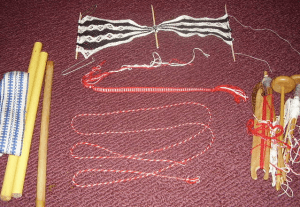
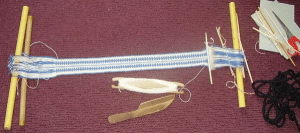
It was about time I made a decent backstrap for my loom. This runs across the back of my hips, with the tails on either end of the warp beam; with the other end of the warp tied to a solid object, leaning back a bit adds tension to the warp to make it easier to weave. The other parts are: heddle bar; shuttle; sword; and a warp spreader.
2012 – An Tir A&S
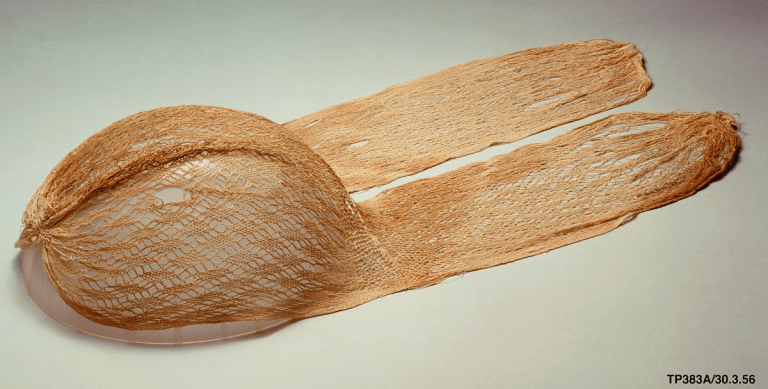
In 2012, bouyed by my experience with my single entry in the Tir Righ Arts and Sciences Competition, I wrote to the British Museum about one of their språng items on display. The curators were kind and helpful, though not able to give me additional information.
By February, I had exchanged emails with the Met Museum (curators Marsha Hill, Morena Stefanova, and Linda Seckleson). They suggested publications for further research. I was not able to get the one German publication suggested, and did find the article, “In situ: What the Find SpotTells Us about Sprang Fabrics” by Petra Linscheid (in ‘Textiles in Situ: Their Find spots in Egypt…” etc, Riggisberger Berichte, Vol. 11, 2006). Three layers, three headdresses on a skull! Cap, tailed bonnet, etc. She also posted on www.digitalegypt.ucl.ac.uk/textil/hairnets.html in 2002 regarding two styles of cap (densely worked wool cap, and linen and wool hairnet).
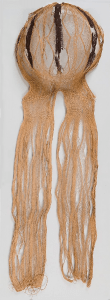
My queries regarding how the museum determined it was a child (by size), and determined the date (well…). Back and forth a few times, I suggested the headdress resembled items elsewhere that were dated a few centuries later. I received an email back that, based on our conversations, they decided to change the find’s date much closer to my thinking!
It was this museum piece where I learned about uneven tension between the two ends, on moving the twists in order to control the fall of the midline. This piece had been worked by pushing the twists firmly to one end, and the echoing twists more gently to the other. When the looser
end was split into a pair of tails (by removing one thread), the tails were long enough to wrap around the head.
Since I loved the pattern, I carried that thought forward.
Online, I found Door E. Seiwertsz van Reesema’s Egyptisch Velchtwerk, and “Een Oud-Egyptische Muts”. Google Translate played hob with it, translating from Dutch to English, but extrapolation of “wire” to “thread” helped me work out some of the other text. Although I learned much from it, I don’t agree with her interpretation of how the “tailed bonnet” was worn.
(I also found a “Bulletin of the Metropolitan Museum of Art”, and ‘Three Egyptian Turbans of the Late Roman Period’; details will be used in a future version of the headwrap.)
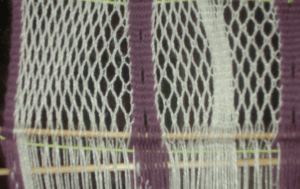
2012 March 3-4, single entry An Tir A&S Competition: “Coptic Wrapped Språng Headdress”: a white linen and purple wool version of a “headdress from the head of a mummy of a child” (Accession Number: 90.5.33), in the Metropolitan Museum of Art.
(My documentation was unusual in that the re-creation was described before description of the original; don’t do that.)
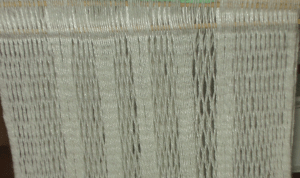
I had some issues with recreating the pattern, and opted to finish it more simply. Another item I want to return to for further effort.
2018 – Tir Righ A&S
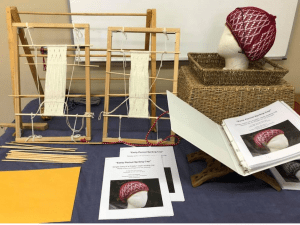
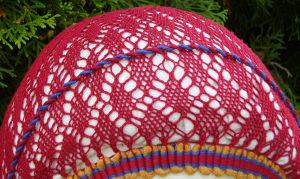
2018 Sep 22, Tir Righ A&S Championship, single entry: “Early Period Språng Cap”: a red patterned cap based on a Coptic period design, with backstrap-woven forehead band.
This was my first competition piece where I incorporated ideas from various pieces into an original design, rather than attempt to copy an extant item.
Done in long-fibre cotton (it’s what I had), I used the stitch pattern from the single-color Coptic wrapped headdress in The Met, the overall shape of most Coptic short-tailed caps in the Kelsey, and the thick-and-thin woven forehead band of cotton and linen from several fragments at the Kelsey.

As an aside, I received many compliments on the handout! This is my current favorite to wear.
Fun Things
Some things that are not necessarily SCA period, but are either plausible, or just fun. Possibly both.
Pouches for largesse
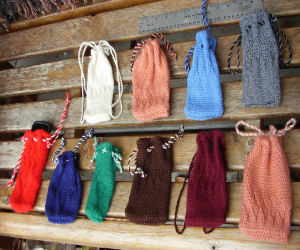
Most of my classes involve teaching people språng work through these useful items. We start with plain work, and we try for the eyelets (my personal preference) for the drawstring; those who are familiar with plain work get to try twist-patterns.
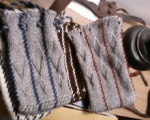
These pouches are fun for me! My first ones of this style were sized for cellphones, with a hanging loop for the belt. Made in acrylic yarn, they are both padded, and hard-wearing. Not only cellphones, but pottery cups benefit from the protection these pouches offer.
Silk garters for Aspasia Bevilacqua
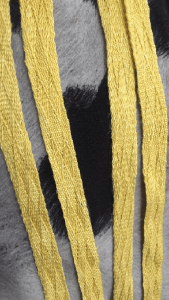
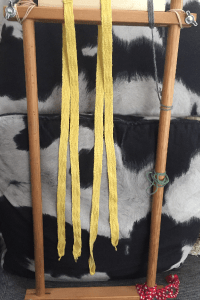
Aspasia Bevilacqua was looking for garters to go with her new set of clothing. Fortunately, she had some lovely silk yarn of the correct color. After some measurements, and some test runs, I turned an embroidery slate on its side to warp the yarn. I took a bit of a gamble by working each garter separately, the gamble being that the twist must be packed with even tension; however, I measured the warp for both at the same time, and could compare the completed one with the second one as I went. The pattern is created by changing the direction of the twist.
Caps
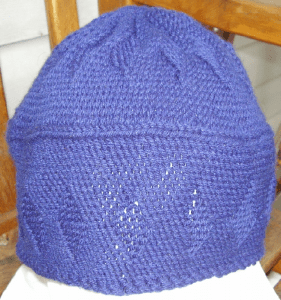
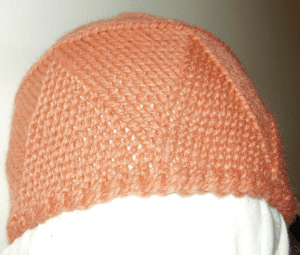
Everyone needs a sexy cap! One is in acrylic yarn, and the other in wool yarn. With the elasticity of the fabric, one size pretty much does fit all. Note that the mid line is visible half-way up the fabric. The top of each is gathered on a cord and tied; that gathering isn’t seen often in period items, but does exist. The opening is chained to provide a relatively firm (if elastic) edge. As you might notice, these demonstrate my favorite twist pattern.
Shoppers
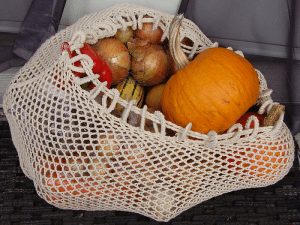
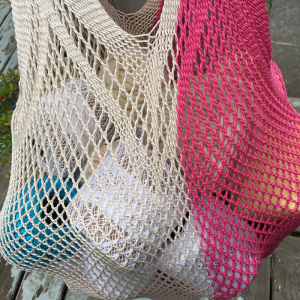
As we remove plastic bags from our household, it became an opportunity to do more språng! (Sewn shoppers just didn’t get me excited.) Made in cotton, they are machine washable, and expand to hold almost anything you please. These projects were large enough that I used a Salish-type tapestry loom as my frame. For all the immensity of the single-color shopper, making the lark’s-head loops for the drawstrings took longer than the entire body of the bag, which was time-consuming enough. (I’ve been asked if someone could buy one of these. At minimum wage, these are beyond the pocketbook of most people. On the other hand, I teach; it’ll take around forty or so hours to make a shopper.)
Did someone ask “Do you teach”?
Yes, I teach classes. In-person classes may include a kit of a simple frame, beam sticks, multiple thin sticks to maintain the twist while working, yarn, and a latch hook to chain the mid line and ends. I use a simple crochet hook for the last couple of rows of work, and a blunt needle for whatever sewing is needed to join edges.
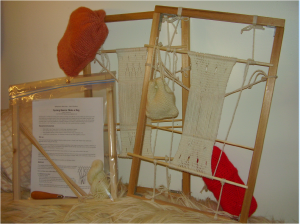
Tools are not complex! As you see, a smaller project will fit into a ziploc bag.
You can make a frame out of bent willow, or a trapezoid of branches, and be very early traditional. You can use a standing tapestry or Salish-style loom as a frame. Yet, my first frame was a wire, office in-basket.
Your beam sticks can vary according to the size of project. My small projects tend to be on chopsticks or sturdy knitting needles.
Yarn should be smooth, at least for the first few projects. For cotton, use #3 or #5 crochet cotton. If using wool (or acrylic), look for smooth worsted yarn with multiple plies. Have some sturdy extra yarn for mounting your beam-sticks to your frame.
Instruction is available.
What is ahead?

I have more learning ahead about intertwining, supplemental warps, and doubled fabric.
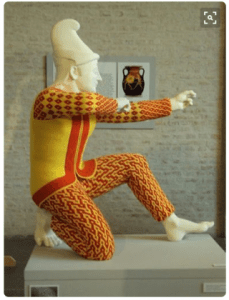
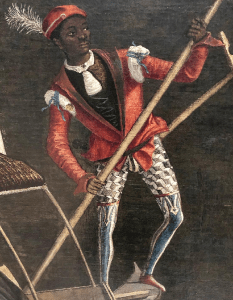
Relic of the Cross at Ponte di Rialto”, circa 1496 CE.
I’d like to make the apparent onesie of a Persian archer, or some tights like those of the gondoliers.
Also on the list is finding a copy of “The evolution of the Islamic Vestimentary System”, which describes about 70 items in the Geniza Trousseaux, of which more than half are veils and headwear.
Want to know more about språng and the history of the technique?
Read on with Athenaeum 2!
 Molten Midnight Creative