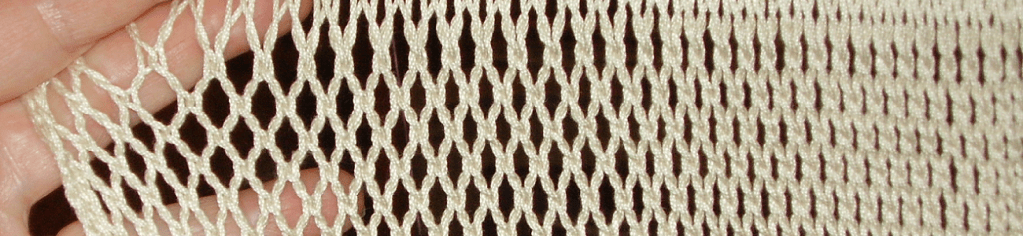
The Språng Journey of Halima al-Rakkasa, continued…
What is Språng?
This is a textile technique for making fabric from thread/yarn, much like braiding. Peter Collingwood, noted textile artist, describes it succinctly as “plaiting on stretched threads”. Threads are anchored at both ends, or laid out in a circular warp, and manipulated in a braiding fashion.
As each twist is formed and pushed to each end, the fabric is built both above and below the working area. The resulting fabric can be very elastic (with interlinking), or less so (with interlacing). With the third technique of intertwining, many open, closed, and layered fabrics can be created. One of the creative challenges is that the final size of the product is restricted to the threads laid out in the beginning.
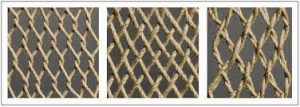
The triplet image shows differences between interlinking, interlacing, and intertwining. Complexity comes with grouping twists, with color, and with layering.
To date (2021), I have only explored the first two of the three basic techniques, especially interlinked.
What is Interlink Språng?
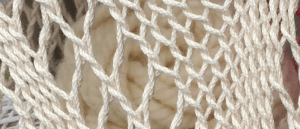
Think “chain-link fence”: that’s the basic structure of interlink. The simplest fabric is made by twisting pairs (usually) of warp yarns, exchanging each forward warp with a back warp as a stitch; to ensure the linking, the start of alternating rows exchange two front with one back warp, and continuing with the usual one-and-one stitch. The stitches are done in the same order, the same direction (either Z-twist or S-twist), unless a pattern is introduced.
What is Interlace Språng?
Think “bias”; the simplest one is single warps, front and back, in a stitch. However, to create the bias, rows alternate in the direction of the twist. Interlace is not quite as expandable as interlink, yet provides opportunity for another type of pattern creation.
Where Does Språng Originate?
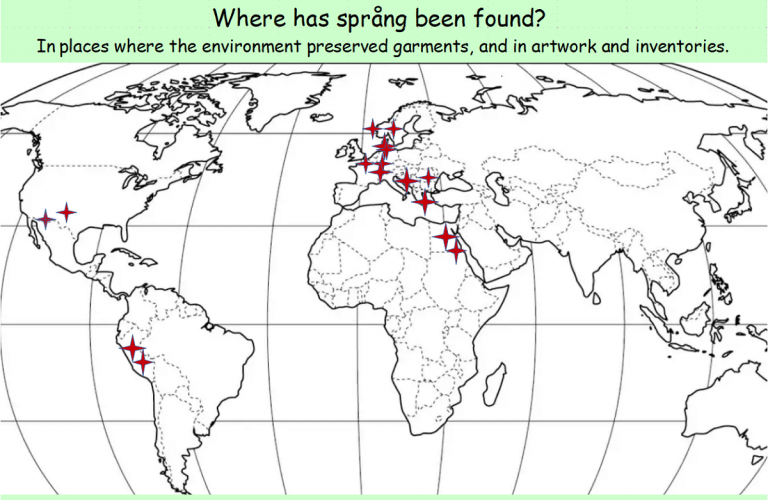
The bulk of found items are in Egypt, with a wide range of techniques. A few pieces have survived the bogs of northern Europe and Scandinavia, such as a hairnet from Bronze Age (circa 1400 BCE) Denmark. The Viking/Migration Era left us a couple of twist-patterned stockings. And a few pieces have survived from the Middle Ages in Europe. In the British Museum is an Elizabethan curtain of språng.
We also have evidence in paintings, frescoes, redware pottery, and woodcuts.
Until recently, I’ve ignored the western hemisphere; now I can include the two pieces from North America (New Mexico, and Arizona), and the tassels from Peru and Bolivia!
See the appendix below for a somewhat more detailed list.
Resources
Regarding the references… They all present språng a little differently: the words describing techniques differ from one author to another, and some work from a different side of the warp. Some just mention språng.
- Collingwood, Peter. The Techniques of Sprang, Plaiting on Stretched Threads, Faber and Faber, New York, USA, 1974. ISBN-10 : 0571101445; ISBN-13 : 978-0571101443
- Clark, Louise. “Notes on Small Textile Frames Pictured on Greek Vases.” American Journal of Archaeology, vol. 87, no. 1, 1983, pp. 91–96. JSTOR, www.jstor.org/stable/504671. Accessed 21 May 2021.
- Crowfoot, Elizabeth. “Clothing of a 14th Century Nubian Bishop”; Studies in Textile History edited by Veronika Gervers; pub Royal Ontario Museum (June 1 1990); ISBN-10 : 0888541929, ISBN-13 : 978-0888541925
- Drinkler, Dagmar. Tight-fitting Clothes in Antiquity and the Renaissance, http://costume.mini.icom.museum/wp-content/uploads/sites/10/2018/12/Drinkler_ed_JP.pdf; last accessed May 20/21.
- Goslee, Sarah. Phiala’s String Page, http://www.stringpage.com/sprang/sprang.html; last accessed May 20/21.
- Hald, Margaretha. Ancient Danish Textiles from Bogs and Burials, The National Museum of Denmark. Fyens Stiftsbogtrykkeri, Copenhagen, Denmark, 1980. ISBN: 8748003123
- James, Carol. Sprang Unsprung, SashWeaver, Winnipeg, Canada, 2011. Available at https://www.spranglady.com/; last accessed May 20/21.
- ibid. Sprang Bonnets from Late Antique Egypt: Producer Knowledge and Exchange through Experimental Reconstruction; https://digitalcommons.unl.edu/cgi/viewcontent.cgi?article=2093&context=tsaconf; last accessed May 20/21.
- Kliot, Julie. Sprang: Language and Techniques, Hedgehog Handworks. ISBN-10 : 091689603X; ISBN-13 : 978-0916896034
- Kwaspen, Anne. “Sprang hairnets in the Katoen Natie Collection,” Dress Accessories of the 1stmillennium AD from Egypt, edited by Antoine de Moor and Cäcilia Fluck, Tielt, Belgium: Lannoo, 2011. https://www.academia.edu/5403707/Sprang_Hairnets_in_the_Katoen_Natie_collection; and https://www.academia.edu/40365310/Hairnet_KTN_816_01_and_a_similar_find_from_Qarara; last accessed May 20/21.
- Priest-Dorman, Carolyn. Old World Sprang through the Early Middle Ages: A Brief Bibliography; https://www.cs.vassar.edu/~capriest/sprangbib.html; last accessed May 20/21.
Museums of Interest: Note that some museums are not necessarily up on textile genres, so sometimes språng is listed as knitting, or worse. In order of interest.
- The Metropolitan Museum of Art; not always searchable under “språng”.
- https://www.metmuseum.org/art/collection/search#!?q=sprang&perPage=40&searchField=All&showOnly=withImage&sortBy=Relevance&offset=0&pageSize=0&material=Textiles
- https://www.metmuseum.org/art/collection/search#!?q=turban&perPage=40&searchField=All&showOnly=openAccess&sortBy=Relevance&offset=0&pageSize=0&geolocation=Egypt
- Kelsey Museum of Archaeology
- Textile images and descriptions copied from the Kelsey Museum on-line data base of artifacts from Karanis, Egypt. http://users.stlcc.edu/mfuller/KaranisTextiles.html
- Victoria & Albert Museum. https://collections.vam.ac.uk/search/?q=sprang
- British Museum. https://www.britishmuseum.org/collection/search?technique=sprang&dateFrom=2000&eraFrom=bc&dateTo=1650&eraTo=ad&view=grid&sort=object_name__asc&page=1
- Museum of Fine Arts, Boston Fine Arts. https://collections.mfa.org/search/objects/*/sprang/images?page=1;
- Whitworth Gallery, University of Manchester. http://gallerysearch.ds.man.ac.uk/Home/UpdateSearch; search on sprang
- Brooklyn Museum. (This museum has frustrated me. However, a blogger called The Sojourning Spinner created a list: http://thesojourningspinner.blogspot.com/2013/05/sprang-images-on-brooklyn-museum-website.html)
Appendix – Extant Examples
Språng timeline of finds/sources/hints, more or less from an overview by Collingwood.
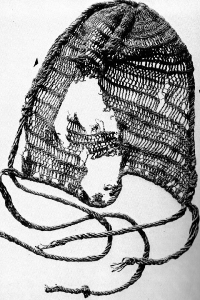
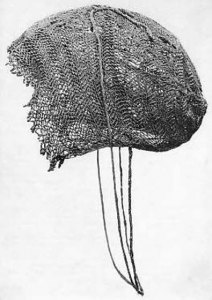
Bronze Age (circa 1400 BCE)
Borum Eshöj, Jutland, Denmark – hair net (back of the head); fine, two-ply wool.
Bredmose bog, Parish of Store Arden, Denmark. “The Arden Woman” (AKA “Bredmose woman”); cap or hood of fine wool; stripes of S- and Z- twist.
Southern Jutland, 1300 BC; “The Skrydstrup Woman”; horse hair hairnet, with cap in two-ply wool over top. Elaborate hair dressing.
Late Pre-Ceramic (c 1100 BCE)
Peru – cylindrical bags and fabrics; possibly cotton.
Hallstatt period (800-500 BCE)
Haraldskrer Mose, Skibetparish, T~rrildherred (Haraldskar Bog at Vejle, Denmark) – hair net of wool singles.
Peru (500-300 BCE)
Paracas Cavernas – decorative pieces with complex base pattern, and figures worked into them.
Peru (300 BCE – 500 CE)
Nazca – includes complex wool neck coverings, and simple interlaced bags.
100 CE
Vindonissa, Switzerland – fine wool with triple twist interlinking.
La Tène Period (500 – 50 BCE) – charred items that includes a fragment of interlinking.
Greece (500 BCE and onwards)
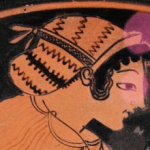
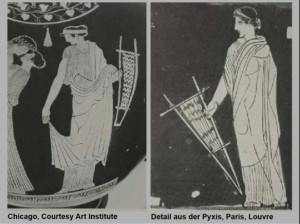
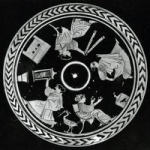
Greek finds – vase paintings showing women with frames, and items on the wall behind them. Språng items on coins, sculptures, and paintings.
Roman Iron Age
Blidegn, Denmark – fragment of interlinking.
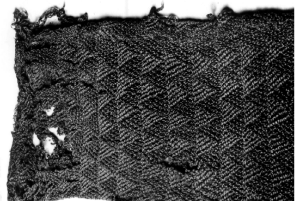
Migration Period
Tegle, Jaeren, Norway – earliest in Norway; tubular fabric with twist patterning; both ends finished with tablet-weaving.
Viking Period (c 850 CE)
Oseberg, Norway – signs of tools, and (elsewhere) fragments and “impressions” on various items.
Micklegate Bar, York, England – two-ply wool stocking in twist-patterned stripes.
Achmin, Egypt (mostly) – “Bags” and caps in Coptic graves, in undyed linen and/or dyed wool; finds include turbans and other garments; much complex patterning.
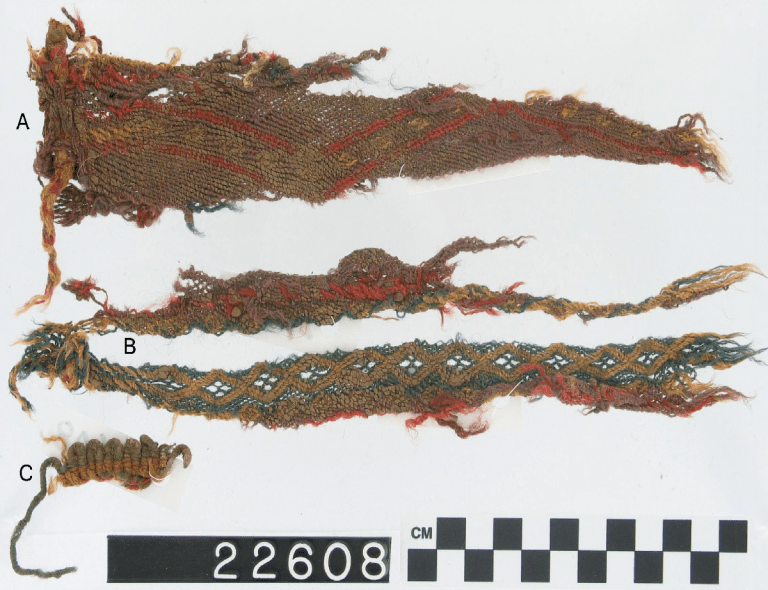
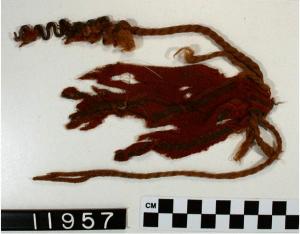
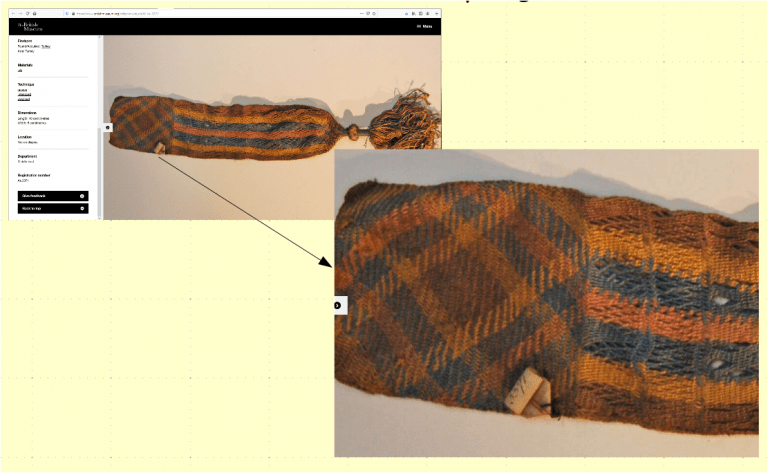
See both of these two pieces in the Kelsey Museum.
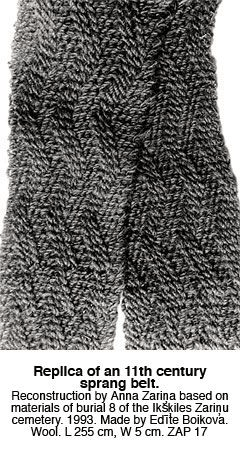
Latvia, Ikšķiles Zariņu cemetary. Image on the left is a replica of an 11th century sprang belt from Grave 8. At the National History Museum of Latvia (http://www.history-museum.lv/english/pages/krajums/izpete-atdarinajums.php).
Iceland – språng altar cloths listed in church inventory.
1100-1300 CE
Mule Creek Cave, New Mexico, USA – a strip of two-ply cotton with hole designs on interlinking.
1300-1500 CE
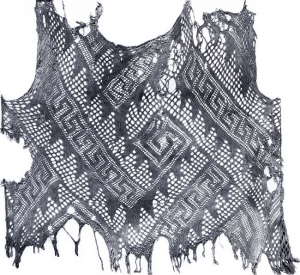
Arizona State Museum – Salado språng tunic, AKA Tonto Monument shirt; 14th C, in cotton.
“SPRANG TUNIC –
“Culture: Salado – Dates: ca. AD 1300-1450
“– Location: Tonto-Roosevelt Basin, central AZ
“– Material: cotton
“– This sleeveless tunic was made by a non-loom technique known as sprang which creates an interlinked structure. The fiber is handspun cotton. The design motifs–running triangles and in-terlocking rectilinear scrolls–are also found on contemporary painted pottery and petroglyphs.)]“
(Quote from https://nautahistoriae.files.wordpress.com/2019/01/c3e3d-2007sprangavs.pdf.pdf)
The museum now displays an accurate reproduction by Carol James, Winnipeg, Manitoba. She has documented the entire process of creating it, and notes the team members involved.
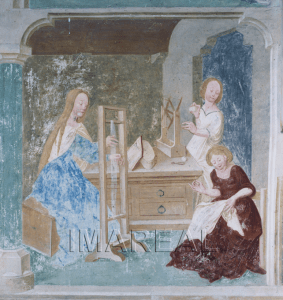
Slovenia, 1504 CE – Mary at the Loom, fresco at the Church of St. Primus and Felicianus.
15th C
Switzerland – fabric with complex hole designs, some embroidery.
16th C

Belgium – woodcut of a woman working at a språng frame.
France – “Planet Venus and her children“, early 16th C, in the book “Die textilen Künste“, by Leonie von Wilckens – engraving of a woman working at a språng frame.
17th C
Transylvania – silk caps and girdle.
Scandinavia – references in written records to språng work in inventories, wills, and autobiographies.
This above list is limited to what Peter Collingwood found, as of 1974, with some additions from me, and only those items within the SCA time period (as of 2021); imagine what else has been found since then. These are also part of my inspiration, along with museum pieces.
The journey has not yet ended.
To read about the Journey these items inspired, see Athenaeum 1.
 Molten Midnight Creative